Radon is the leading cause of lung cancer among non-smokers and the second leading cause overall. Here in East Tennessee, including Oak Ridge, Knoxville, and surrounding EPA Zone 1 counties, homes regularly test above the EPA's 4.0 pCi/L action threshold. Getting a mitigation system installed is a smart, life-protecting decision. But the quality of that system depends entirely on the radon mitigation company doing the work. The national standard governing radon mitigation, ANSI/AARST SGM-SF 2023, sets clear minimum requirements for every contractor. Here is what you should ask before you sign anything.
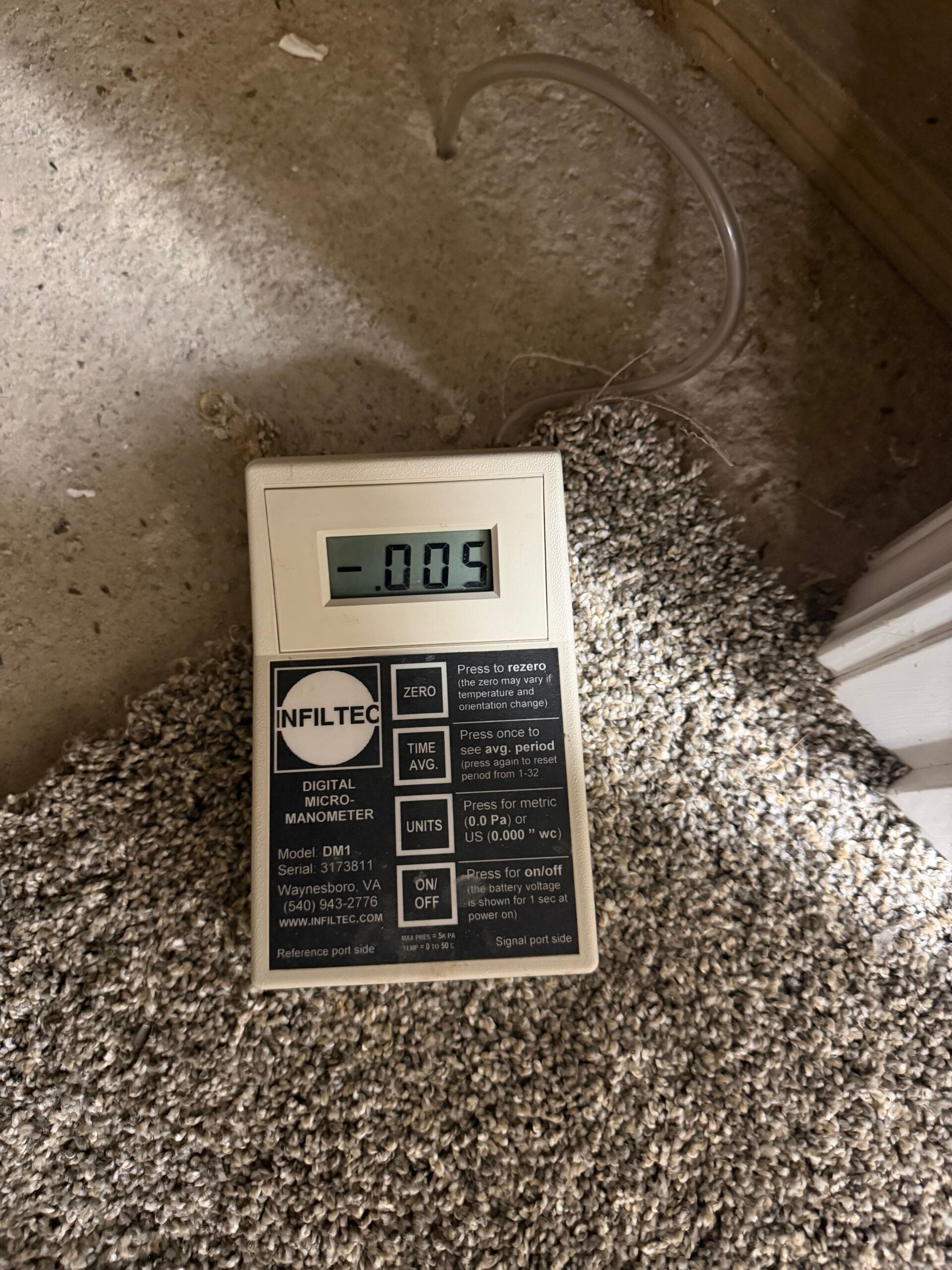
An Infiltec DM1 digital micromanometer measuring sub-slab pressure during pre-installation PFE testing. Rn86 Solutions performs this diagnostic on every job before a single hole is drilled.
ANSI/AARST SGM-SF 2023 · Sections 3.2 & 13.1
The national standard requires that every radon mitigation company include at least one qualified radon mitigation professional. That individual must hold a current, active certification through a nationally recognized program such as the National Radon Proficiency Program (NRPP) or the National Radon Safety Board (NRSB). That certification requires a minimum of 32 hours of education specific to radon mitigation, plus biennial recertification to stay current.
Certification matters because it means the person designing and overseeing your system has been tested on the science of soil gas dynamics, pressure field extension, pipe sizing, fan selection, and post-installation verification. When field conditions change mid-installation, and they often do, a certified professional makes better decisions faster.
Multiple members of our installation team hold active NRPP mitigation certification. We believe having a certified professional on the ground, not just on paper, leads to better systems and better outcomes. When a field condition requires a design adjustment, we have the right people standing right there to make the call.
ANSI/AARST SGM-SF 2023 · Sections 3.1, 3.4.2 & 8.5
The standard permits journey-level installers to perform physical installation work, but only under the direct responsible charge of a qualified mitigation professional. That professional is required to verify the completed installation for standards compliance, correct design execution, and applicable local codes before the system is officially signed off as complete.
The key word here is verify. A drive-by inspection at the end of the day does not meet the standard's intent. If the person overseeing your job is not present while the work is happening, problems can be missed that are much harder to correct after the fact.
A certified Radon Mitigation Professional is on-site from the first drill to the final system check on every installation we do. We never send a crew out without qualified oversight present the entire time. No exceptions.
ANSI/AARST SGM-SF 2023 · Sections 5.3.5 & 9.1.3
Pressure Field Extension testing, sometimes called communication testing or PFE analysis, is how a qualified radon mitigation company determines whether an ASD (Active Soil Depressurization) system will actually work before drilling a hole and routing pipe. It measures whether a vacuum applied at the suction point extends effectively across the sub-slab area, how much airflow the system will need, and whether the chosen suction point location is optimal.
The AARST standard requires pre-installation PFE analysis to guide system design, and it requires post-installation depressurization testing to confirm the system is performing as expected before it is released to the homeowner. Skipping pre-installation PFE is like designing a heating system without measuring the rooms. The results will be inconsistent at best and ineffective at worst.
PFE testing is the first thing we do on every job, before we make a single cut. It tells us exactly what conditions exist under your slab and lets us design a system around your home's actual geology, not a generic template. We then verify performance again after installation with documented pressure readings, so you have proof, not just a promise, that your system is working.
The Appalachian geology in Anderson, Knox, and Blount counties creates highly variable sub-slab conditions. Sometimes it is permeable gravel fill and sometimes it is dense clay that resists vacuum extension. PFE testing accounts for this variation. A system designed without it may look installed correctly but fail to protect your family.
ANSI/AARST SGM-SF 2023 · Sections 6.2.5 & 6.3
Pipe sizing is not one-size-fits-all. The national standard specifies that ASD duct piping must be sized based on the actual airflow volume needed to create an effective vacuum under your specific slab. The baseline minimum is a 3-inch Schedule 40 inner diameter pipe. If PFE analysis shows the system needs more than 80 cubic feet per minute of airflow, the standard requires a 4-inch pipe.
All piping must be rigid, non-perforated PVC or ABS Schedule 40 with solvent-welded, airtight joints. A radon mitigation company using undersized conduit, flexible pipe, or lightweight downspout material where proper pipe is required is not meeting the standard, and your system will likely underperform as a result.
We use 3-inch and 4-inch Schedule 40 PVC throughout, for both suction and exhaust. The size we select for your job is determined by the PFE airflow data collected before installation begins, not by what happens to be on the truck. Every joint is solvent-welded and airtight.
ANSI/AARST SGM-SF 2023 · Sections 8.2.1 & 8.2.2
The national standard mandates two layers of monitoring on every fan-based mitigation system. The first is a continuous visual monitor, typically a U-tube manometer or equivalent gauge, that shows whether the system is operating within its normal pressure range. The second is an active notification monitor that alerts occupants if the fan fails, through an audible alarm, a visual light signal, or electronic notification.
Think of it like a smoke detector for your radon system. If your fan stops working tonight, indoor radon levels will begin to rise. Without an audible alarm, you may not know for weeks or months. A passive gauge alone, one you have to walk over and look at, does not provide active protection.
An audible alarm is included in every Rn86 quote as standard equipment. It is never an add-on and never an upcharge. The standard requires it, and we agree with the standard. Your system should protect you even when no one is looking at it.
ANSI/AARST SGM-SF 2023 · Sections 9.2, 9.2.1 & 9.2.2
The AARST standard requires a short-term post-mitigation radon test to be conducted no sooner than 24 hours after the system becomes operational and within 30 days of installation. All testing devices must be approved by NRPP, NRSB, or an equivalent nationally recognized program. The standard also explicitly states that contractors should recommend independent, third-party testing to avoid any appearance of conflict of interest. No radon mitigation company should be the only one grading their own work.
Post-mitigation testing is a standard part of every Rn86 installation, not an optional upgrade. We conduct it per AARST protocols and actively encourage clients to also commission independent third-party testing. If our results and an independent test match, you have complete, documented confidence in your system. That is the outcome we want for every home we work in.
ANSI/AARST SGM-SF 2023 · Section 9.2.2 & ANSI/AARST MAH Measurement Protocol
The standard requires that all post-mitigation test devices be listed and approved by a nationally recognized program and that all testing follow the ANSI/AARST MAH measurement protocol. Not all devices meet this bar, and not all testing approaches deliver the same quality of results.
A Continuous Radon Monitor (CRM) logs radon levels hourly for the full duration of the test, providing a detailed picture of how the system performs across a range of conditions. It captures data day and night, with HVAC running, and at rest. A charcoal canister test captures a single time-averaged snapshot that can be skewed by humidity, temperature swings, placement error, or even deliberate tampering. CRMs also include tamper-detection features that make results defensible to third parties, real estate agents, and future buyers.
Every post-mitigation test we conduct uses an NRPP-approved, professionally calibrated Continuous Radon Monitor. We do not use charcoal canisters for post-mitigation verification. The data we give you, logged hour by hour over 48 or more hours, tells the full story of how your system is performing, not just a single snapshot that may or may not represent your home's real conditions.
Charcoal canisters measure an average radon concentration over 48 to 96 hours and must be mailed to a lab for analysis, adding days to the process. Continuous Radon Monitors provide hourly data in real time, detect anomalies during testing, and are significantly harder to manipulate. For post-mitigation verification, where the result matters for your family's health and your home's resale value, the CRM is the professional standard.
Ready to Work with a Radon Mitigation Company That Does All of This?
Rn86 Solutions serves Oak Ridge, Knoxville, and the surrounding East Tennessee region. Every installation is NRPP-certified, AARST-compliant, and backed by post-mitigation testing you can trust.