NRPP-Certified Measurement Professionals
Professional Residential Radon Testing in East Tennessee
Radon is a naturally occurring radioactive gas that is invisible, odorless, and tasteless. According to the EPA, it is the leading cause of lung cancer among non-smokers. In East Tennessee's high-risk geology, professional testing is the only way to ensure your home provides a safe environment for your family.
The Science of Radon: How It Enters Your Home
Radon gas is produced by the natural radioactive decay of uranium in the soil and rocks beneath your foundation. While radon is present outdoors in very low concentrations, it becomes a health hazard 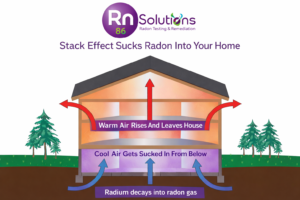 when it enters the confined spaces of a home and accumulates to elevated levels. The physical process that drives radon entry is known as the "Stack Effect."
As warm air rises and escapes through the upper levels of your home, it creates a zone of negative air pressure in the lower levels. This pressure differential literally sucks radon gas out of the soil and through the smallest openings in your foundation. Even a "tight" modern home is susceptible to radon entry through:
- Cracks in concrete slabs
- Construction joints and seams
- Gaps around service pipes and utilities
- Open sump pump pits
- Pores in hollow-block walls
- Dirt floors in crawlspaces
Because Oak Ridge and Knoxville are situated within the Ridge and Valley geologic province—an area known for its uranium-rich shale and limestone—the potential for elevated indoor radon levels is significantly higher than the national average. This is why Residential Radon Testing is considered an essential health screening in East Tennessee.
Understanding the Health Implications
The Surgeon General and the EPA have classified radon as a Group A Carcinogen. When you breathe in air containing radon, radioactive particles become trapped in your lungs. As these particles break down, they release "alpha particles"—small bursts of energy that damage lung tissue and cause cellular mutations. This cumulative damage can lead to lung cancer over time. The risk is dose-dependent: the higher the radon level and the longer the duration of exposure, the greater the statistical danger to your household.
The Solution: Professional Measurement
Radon levels are highly localized; two identical houses sitting side-by-side can have vastly different radon concentrations based on foundation type and soil porosity. Rn86 Solutions utilizes state-of-the-art Continuous Radon Monitors (CRMs). Unlike passive charcoal canisters, our active devices provide hourly data points, allowing us to account for weather-related fluctuations and ensure the integrity of the test.
Adherence to ANSI/AARST MAH-2023 Protocols
Rn86 Solutions strictly follows the ANSI/AARST MAH-2023. This standard represents the latest industry consensus for residential measurement. Our adherence to these protocols ensures your data is accurate and legally defensible:
Multi-Location Planning
Large homes or homes with multiple foundation types require testing in every separate "foundation zone" to ensure no livable area is overlooked.
Closed-Building Compliance
MAH-2023 requires all exterior doors and windows to be closed for 12 hours prior to and during the test to simulate a "worst-case" radon environment.
Tamper Detection
Our monitors track motion and pressure. If a device is moved or a window is opened, we see it in the data, ensuring the validity of your results.
Short-Term vs. Long-Term Testing
| Testing Feature | Short-Term (Standard) | Long-Term (Extended) |
|---|---|---|
| Primary Goal | Rapid "Snapshot" for home sales or initial screening | Evaluation of true year-round average exposure |
| Measurement Period | 48 Hours to 7 Days | 90 Days to 365 Days |
| Regulatory Use | Industry standard for real estate transactions | Recommended for chronic health monitoring |
Radon in Real Estate Transactions
If you are buying or selling a home in East Tennessee, Residential Radon Testing is often a non-negotiable part of the home inspection. When a home tests above the EPA Action Level of 4.0 pCi/L, a certified mitigation system is strongly recommended.
The EPA Action Levels
- 4.0 pCi/L or Higher: The EPA "Action Level." Reliable mitigation is strongly recommended.
- 2.0 to 4.0 pCi/L: The EPA suggests considering mitigation, as risk persists even at lower levels.
- Zone 1 Data: Because our service area is in a high-risk zone, many homes in Oak Ridge and Knoxville routinely test above 10 pCi/L.
Residential Radon Testing: Frequently Asked Questions
Q: Can I just use a hardware store kit?
A: DIY kits are passive collectors prone to user error. Professional Residential Radon Testing uses active monitors that record environmental changes, providing higher accuracy and a tamper-resistant report.
Q: My home is on a slab. Do I still need to test?
A: Yes. Radon penetrates slab-on-grade homes through microscopic foundation pores and utility penetrations. Many high-radon homes in our area are slab-on-grade.
Q: How often should I re-test?
A: The EPA recommends re-testing every two years, or anytime you perform major renovations or change your HVAC system.
Ready to Know Your Number?
Don't leave your family's health to chance. Rn86 Solutions provides the certified testing you deserve.